
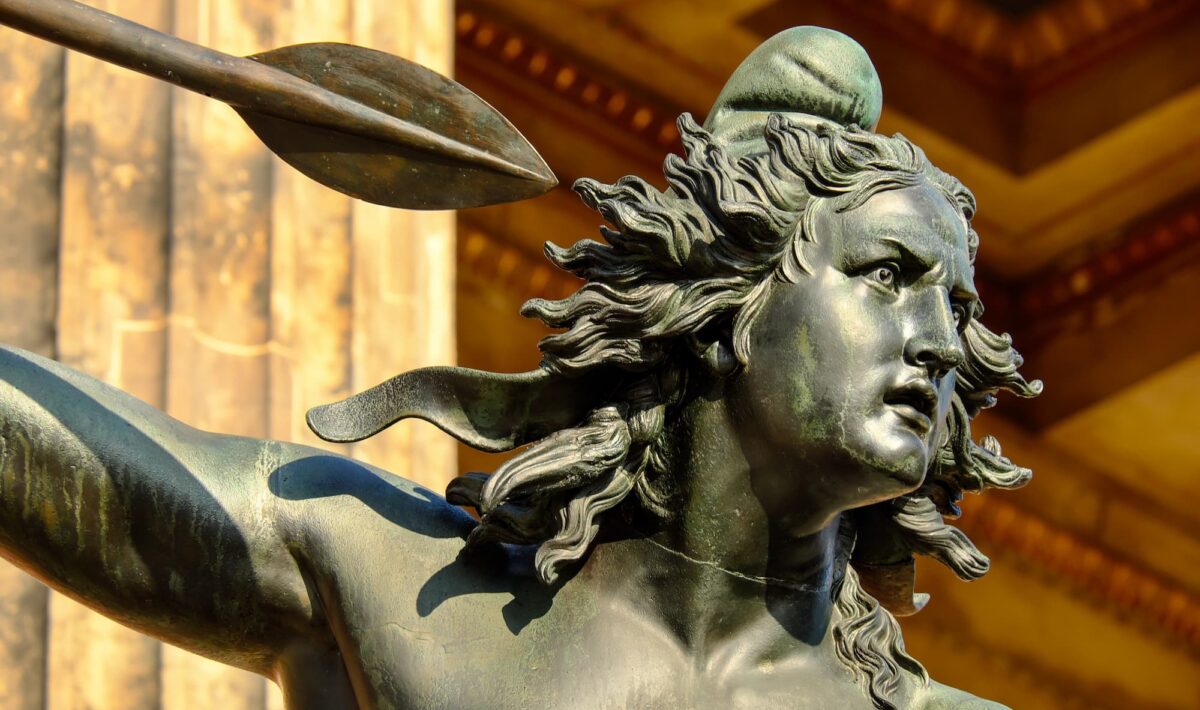
A sculpture does not necessarily need a pedestal. Nor does an artwork have to remain still, protected by a velvet rope and observed from a careful distance.
Contemporary artists have spent decades testing those boundaries. They work with installations, performance, sound, clothing, architecture, and objects that only become complete when someone interacts with them. In that context, wearable art feels less like a separate category and more like a natural extension of sculpture and modern-era art.
A costume can carry color, texture, symbolism, and narrative in the same way as any object displayed in a gallery. The difference is that it moves. It changes shape as the wearer walks, turns, sits, or raises an arm. Light catches different surfaces. Fabric folds. Try to look at the painted edges reveal themselves for only a moment before disappearing again.
The work is never seen in exactly the same way twice.
When Sculpture Begins to Move
Designing something for a human body introduces problems that static sculpture can ignore.
A dramatic silhouette may look perfect in a drawing but become uncomfortable after ten minutes. A large shoulder piece can shift the wearer’s balance, while a beautifully layered chest design may restrict breathing or movement. Weight, attachment points, flexibility, and heat suddenly become part of the artistic discussion.
These limitations do not reduce creativity. Quite often, they make the design more interesting.
The artist has to decide which details matter most, where materials can bend, and how the object should respond when the wearer moves. Every solution changes the final appearance, sometimes in ways that could never have been predicted from the original sketch.
Designing for a Living Canvas
The human body is not a neutral display surface. It is a unique masterpiece on its own.
It has defined proportions, habits, and limitations of its own. A piece designed for one wearer may sit differently on another, while movement can make certain details more visible and hide others entirely.
That is what separates wearable sculpture from costume decoration. The body becomes part of the composition rather than merely carrying it.
Fantasy as Contemporary Art
Fantasy design is often dismissed as entertainment, yet it uses many of the same methods found in contemporary art: symbolic forms, invented cultures, exaggerated proportions, unconventional materials, and narratives expressed through objects.
A fantasy helmet may borrow from medieval armor, insect anatomy, religious architecture, or industrial machinery. A cuirass might suggest the history of a fictional kingdom without explaining that history in words. Scratches, colors, emblems, and surface treatments all contribute to the character before the wearer speaks. A great example is the film The Green Knight (2021).
Independent creators increasingly develop these ideas through specialist workshops and a professional LARP shop, where concept art can be transformed into polyurethane armor, accessories, and wearable objects rather than remaining a static illustration.
The process often combines several disciplines and techniques. Illustration defines the visual direction of the art piece. Sculpting (traditional or digital via ZBrush, Fusion 360, or other software) gives the design volume. Mold making and casting reproduce complex surfaces. Painting creates depth, age, and the illusion of metal, stone, bone, or something entirely imaginary.
Materials Shape Expression
Material choice affects more than durability. A great example is that steel carries physical weight and historical associations. Leather bends, ages, and records use. Fabric introduces movement and softness. Foam allows large forms to remain light, while modern casting materials can preserve detailed sculptural surfaces without requiring the wearer to carry the weight of solid metal.
An artist working with wearable objects therefore chooses materials partly for their practical qualities and partly for what they communicate.
A surface that looks heavy may feel surprisingly light. Something that resembles ancient metal may have been created using digital sculpting, silicone molds, resin casting, and layers of carefully applied paint.
The illusion is part of the work.
The Audience Becomes Part of the Artwork
In a gallery, the viewer usually stands outside the artwork. In live action roleplay, that separation begins to disappear.
The wearer moves through an environment while carrying the piece. Other participants react to it, photograph it, build stories around it, and interpret what it suggests about the character. The object becomes part of a larger performance that may continue for hours or even days.
This changes the role of the audience. They are no longer simply observing a finished artwork. They help activate it.
A piece of fantasy armor displayed alone may be appreciated for its form and craftsmanship, but once it is worn, it gains posture, gesture, movement, and context. It becomes something closer to a living installation.
Perhaps that is where wearable fantasy art becomes most relevant to contemporary practice. It does not ask people to choose between art and entertainment, or between sculpture and costume. Instead, it allows all of those categories to overlap.
The result is an artwork that can be touched, carried, altered by movement, and remembered as part of an experience rather than as an object viewed from across a room.
